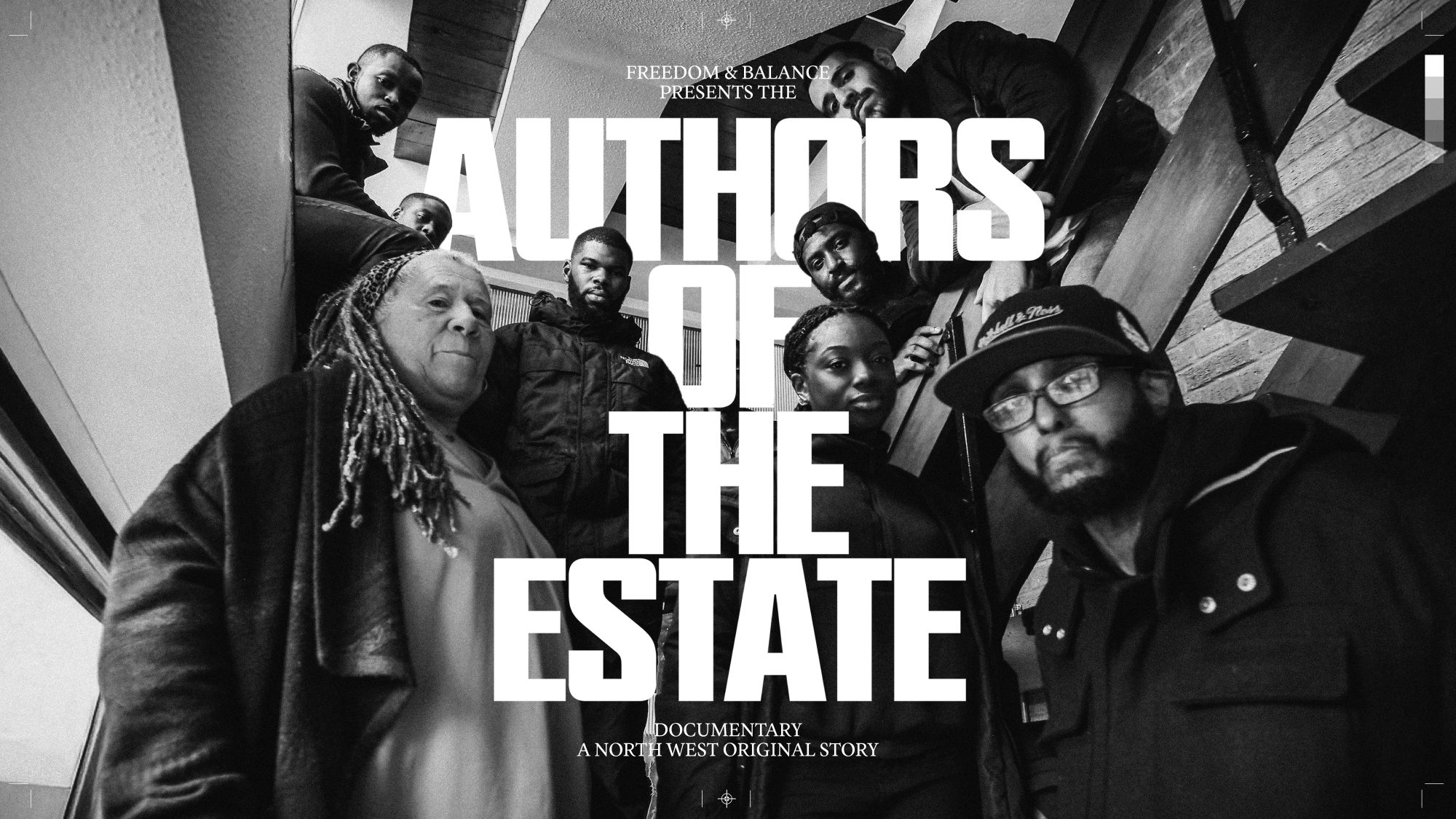
Authors of the Estate
Turning council houses into publishing houses: A screening of a documentary celebrating a community reclaiming their story.
In February Common/Wealth hosted a very special film screening of The Authors of the Estate followed by a talk with the creators, Nabil Al-Kinani, Abdou Cisse, and André Anderson.
We also screened From 19 to 19 – Cardiff Race Riots/Community Resistance. Director Gavin Porter and actor/ poet Ali Goolyad joined the post-show discussion. From NW London to Butetown and Grangetown!
The Authors of the Estate is a powerful new documentary which celebrates a community reclaiming their story. The documentary follows a project where residents of a council estate wrote their stories, turning council houses into publishing houses.
Only 1 in 10 authors in Britain are working class. Working class neighbourhoods often become reduced to an aesthetic to brands, a scapegoat to politicians, and a target to developers – Authors of the Estate changes all that. What began as a grassroots publishing project has evolved into a documentary that amplifies those voices, bringing their words to life and inspiring the next generation of writers from estates across the United Kingdom.
What started as a simple idea to help the neighbours of the St. Raphael’s Estate and Chalkhill Estate in NW London, connected through storytelling, has since grown into a movement. A movement not just to write their stories but to own them. These books shattered stereotypes and allowed residents once seen as statistics or nameless faces to emerge as authors, voices of authority over their own lives.
The film celebrates the power of language as resistance, as healing, and as home.
The documentary explores how two residents from neighbouring estates saw beyond the false narratives that defined them. Through redevelopment, stigma, and renewal, they chose to tell their stories before someone else did.
The result is a collection of raw and powerful books that redefine what life on an estate can mean. There is power in seeing your words in print, power in reading your truth aloud to your neighbours, and power in refusing invisibility. André Anderson the founder of the Book series states
“In areas like ours, we have had a long history of our stories being told for us. Our history books framed us from an anthropological lens, passive subjects of bad circumstances, rather than active participants of the UK’s future. Through their writing, these authors reclaim language itself, they reclaim the narrative, transforming the idea of the estate resident from a tabloid trope into an image of resilience, joy, and self-definition. We wanted to make a film immortalizing our process and rationale”
Nabil, the author and main reason André expanded the book series to another estate, owes the book series to his new career as an author. Nabil’s emergence as an author is the driving force behind the book series’ expansion to include an additional estate, a decision influenced by André.
“I think our biggest obstacle in terms of our communities are the perceptions that we have of ourselves. Having first come across ‘Authors of the Estate: written by St. Raphaels Estate’ in 2015, it taught me that you don’t have to be a writer to write, it is when you write and create your own publication that you become a writer. No one is born a writer. Just because you didn’t study an English degree, that doesn’t take away your right to penmanship. St. Raphael’s taught me that the word author makes up the word authority; when you think of leadership or the policies that were created in this country or any other country, it was all written down in black and white on a piece of paper. In today’s digital age, we forget the power of what a tangible piece of paper can actually do.”
The film, inspired by music video culture and our reverence for rappers, captures that energy and shows how small acts of storytelling ripple through a community, changing how people see themselves and how Britain sees them. It doesn’t fit the normal format of a documentary: no abrasive catchy statistics, no poverty porn. Just pure magical realism.
Abdou Cissé, a BAFTA-nominated filmmaker from South London, was originally invited to capture the project behind the books. But as someone who grew up on an estate and lives with dyslexia, the project hit closer to home than expected.
“This one felt urgent and more important than all the big TV shows I’ve worked on,” says Cissé. “I have moved away from the ends, but making this film made me realise how much I missed having a community, how much I had taken it for granted. I started asking myself, when did I stop looking to my estate for inspiration? Why did I start neglecting it whilst the world uses it to sell back the very culture that they stigmatised me for?…So I wanted to make a film that shattered every expectation of what an estate is. To reclaim the artistic hotbed our homes really are. Like Chalkhill and St Raph’s, my estate is full of uncelebrated brilliance, wonder, talent, and history, but it is too often reduced to headlines. This film is a love letter to those people, to those spaces, and to that spirit.
For Cissé, Authors of the Estate became more than a film. It became a guide and a call to action.
“Beyond creativity and liberation, it is about showing André & Nabil did it, so others can do it again. The same way the book series has chapters between each story that teach people how to write, I wanted the film to teach people how to reclaim their voice hence why we made it short enough to fit any pocket of your day so it can be watched where ever when ever”
At a time when working-class voices are being warped and twisted and routinely sidelined, Authors of the Estate stands as proof that creativity does not trickle down. It rises up.
These books are not just paper and ink. They challenge the myth that art belongs to privilege or institutions. They show that imagination thrives right HERE.
Nabil previously joined us at Chapter for his workshop around his book Privatise the Mandem, tackling gentrification and fighting for community and collective ownership. If you haven’t read it – check it out here.